Humza Nusrat

Humza
Nusrat

I'm a medical physicist at Henry Ford Cancer. I study how language-model agents plan radiation treatment, and where they go wrong.

Henry Ford Cancer, Detroit  ·  Assistant Professor, Michigan State University

Pick a number of beams. Each beam on its own is weak. The dose is only high where they cross, and that's how radiotherapy spares healthy tissue.

Beams

About

Radiation can't tell healthy tissue from cancer. Most of my work is about getting the dose where it should go, and knowing how much actually got there.

I'm a board-certified medical physicist (MCCPM) at Henry Ford Health in Detroit, where I work in MR-guided adaptive radiotherapy and radiosurgery. I'm also an assistant professor at Michigan State University. Before that, I was a staff physicist at Sunnybrook Health Sciences Centre in Toronto.

My PhD was in radiation dosimetry and detector development. My research now asks a practical question about language models that plan treatments: when a plan goes wrong, does the fix need a better model, or would a clearer setup and a simple check catch it?

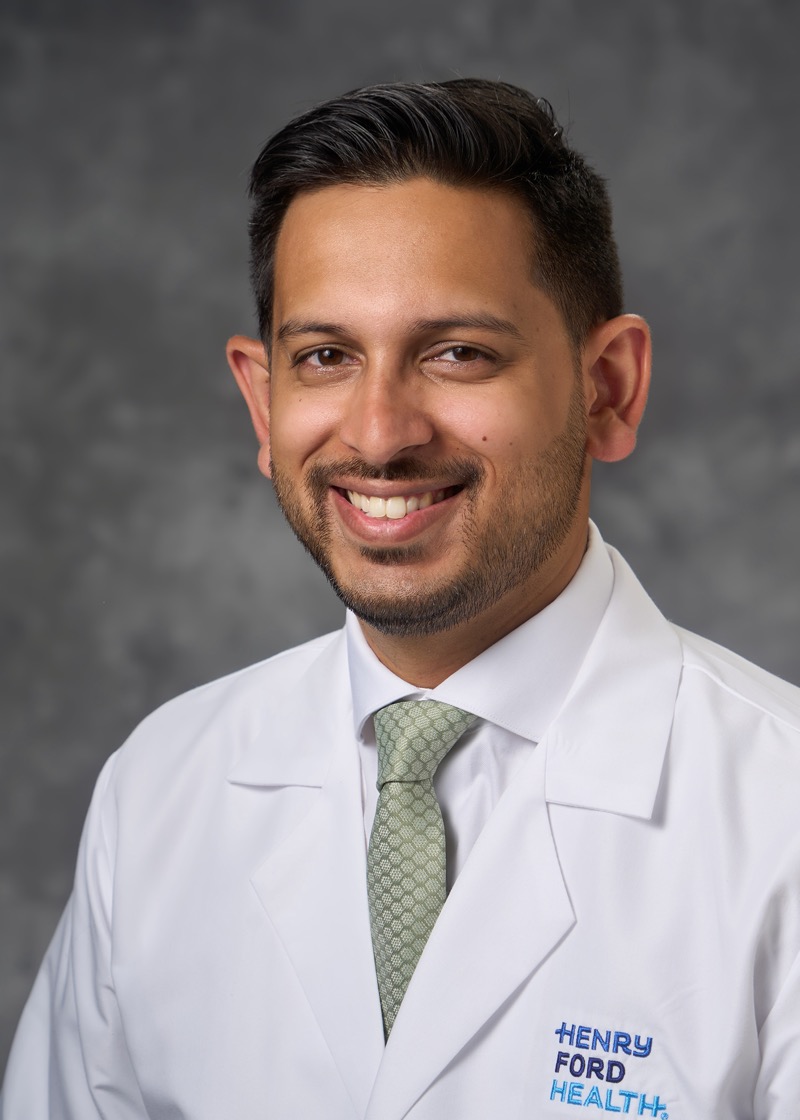
Humza Nusrat in a white coat
Detroit, 2024

Research

SAGE: language-model agents for treatment planning

Planning a treatment usually takes a lot of trial and error: adjust the objectives, recalculate the dose, check it, and try again. SAGE hands that loop to a language-model agent working in the Eclipse planning system, with a physicist reviewing every plan. We tested it on prostate cases and on 41 radiosurgery cases.

Two papers, 2026

Virtual reality training for radiation oncology

Our simulators let trainees rehearse linac safety and HDR prostate brachytherapy in virtual reality before they do either on real equipment, with real patients.

Ongoing

Measuring dose inside an MRI

An MR-linac images the patient during treatment, but its magnetic field changes how dose detectors respond. To measure absorbed dose directly, we built a water calorimeter that works inside the magnet. Calorimetry measures dose through the tiny temperature rise that radiation causes in water.

Published 2020

FLASH radiotherapy

FLASH delivers the whole dose in a fraction of a second. In animal studies, healthy tissue often tolerates it better than a normal-speed dose, while tumors still respond. I'm involved in FLASH research at Henry Ford. In our preprint with Verdi Vanreusel, Stephen Brown and colleagues, we tested flexible scintillating sheets that show the dose across a surface in real time.

Ongoing

Measuring how damaging radiation is (PhD)

Treatment plans assume scattered radiation does the same biological damage as the main beam, but low-energy scatter can do more. For my PhD, I simulated how much that varies, then built a prototype detector for LET (how densely radiation deposits its energy) from lead-doped plastic scintillators. They glow blue under radiation, a bit like Frodo's sword Sting near orcs.

PhD, 2019

Selected papers

Innovations in Calorimetry

Chapter 7 in Recent Advancements and Applications in Dosimetry, ed. Maria F. Chan. Nova Science Publishers. First author.

Full list on Google Scholar

Tools I’ve built

Free tools for people who work in radiation oncology. They're quick references and teaching aids, not a substitute for your clinic's protocols.

Dose Oracle

More than 150 normal-tissue dose limits from QUANTEC, HyTEC, PENTEC and UK SABR, with BED and EQD2 worked out for you.

Protocol Compass

SBRT and SRS protocols for lung, brain, spine, prostate and liver, in one place.

RadOnc.AI

Hands-on lessons for clinicians learning to use language models safely.

Inverse-Square Explorer

Why stepping back from a radiation source cuts your dose so quickly, shown with moving particles.

Side projects

The Walled Web

Which websites block AI? A tracker that checks every day how sites treat AI crawlers, search bots and assistants, and explains the answer in plain words.

Live, 2026

Crucible

Language models debate each other, switch sides, and get scored by a panel of judges. The demo runs on a free server, so it can take a minute to wake up.

Experiment

Path

2025 –

Assistant Professor, Michigan State University

Department of Radiology, College of Human Medicine

2024 –

Senior Staff Physicist, Henry Ford Cancer, Detroit

MR-guided adaptive therapy and radiosurgery.

2021 – 2024

Staff Medical Physicist, Sunnybrook Health Sciences Centre, Toronto

IMRT QA and reference dosimetry lead.

2019 – 2021

Medical Physics Residency, University of Toronto

CAMPEP-accredited.

2014 – 2019

PhD, Biomedical Physics, Toronto Metropolitan University

Radiation dosimetry and detector development.

Recognition

2026

Dr. Margot C. LaPointe Early Career Investigator Award

Henry Ford Health, for the SAGE radiosurgery research.

2023

Global Rising Star in Medical Physics

American Association of Physicists in Medicine, for virtual and augmented reality research.

2021

Sylvia Fedoruk Prize

Best paper in Canadian medical physics, for MR-linac water calorimetry.

2018

Anthony J. MacKay Award

Best student paper, Canadian Radiation Protection Association.

2014, 2017

TA of the Year

Toronto Metropolitan University.

2009

TD Canada Trust Scholarship

Awarded to 20 of more than 7,000 applicants across Canada.

Contact

hi@humza.ai

If you work on treatment planning, dosimetry or AI in the clinic, or you've found a problem in one of my tools, I'd be glad to hear from you.

Google ScholarLinkedInXGitHub